Stock rewards on Robinhood Chain
Buy from the brand.
Own the brand.
Photograph a receipt, or forward the email that came with it, and a slice of that company's stock lands in your wallet as a tokenized share. Every brand on the shelf carries the one figure that decides whether a reward is real: how long it takes to settle. Here that reads in minutes. Elsewhere, in days.
What you buy. What you own.
The brand's rate on the receipt, paid in the brand's own tokenized share. Illustrative, at today's rates and caps.
How it works
Four steps, and one number that tells you whether the fourth of them actually happened.
- 01
Photograph it, or forward it
Shoot the till receipt in the app, or forward the order email to receipts@usestockback.xyz from the address you signed in with. Both routes end at the same place: a claim with a merchant, a date and a total. Paper from the till, confirmations from your inbox, renewals from the subscriptions you already pay for.
- 02
It gets read, not reviewed
A model pulls the merchant, the date and the total, checks that the paper is paper and that the email came from the merchant's own domain, then matches the merchant to its ticker. No queue and no person deciding whether your receipt looks right. A claim is accepted or turned away in the time it takes to read it, and if it is turned away you are told why.
- 03
The reward is priced
The brand's rate, applied to the total, converted at market into the brand's own tokenized share. A $186 Costco run at 2% is $3.73 in COST. Capped at $20 a receipt, or $100 when the wallet holds $STKB. The share is the same one anyone else can buy on Robinhood Chain, issued by a licensed tokenized-securities provider, and it sits in a wallet only you control.
- 04
Watch it settle
From the moment a claim is accepted, a clock runs on the reward until the shares are in your wallet. That time is printed on every brand on the shelf, live, as the median of the last hundred rewards. If it ever reads in days rather than minutes, you will see it before you scan, not after.
Try it against a real receipt
A $186.40 receipt from Costco, at that brand's own rate of 2%. Move the amount, or pick another brand.
$3.73 is 2% of the receipt, converted to COST at market when the claim settles.
A reward is not paid when it is promised. It is paid when it settles.
Every receipt programme has a queue. Most keep it out of sight: a claim goes "in review" and comes out days later, or not at all, and the person waiting never learns which. There is no reason a receipt needs a human to look at it, and no reason you should not know how long the one you just sent will take.
- Median settlement
- 3m 24s
- Human reviewers
- 0
- Accepted to paid
- 1 step
Stockback cannot make a slow brand fast. It can tell you, on every brand and before you scan, how long the last hundred rewards took to land in a wallet. When a claim is accepted here, the shares are bought and sent in the same step. There is nothing left to wait for.
Two routes to the same claim
Paper from the till, or the email that came with the order. The shelf marks which one each brand accepts.
Photograph the paper
Open the scanner on your phone and shoot the till receipt. The text is read on the page in seconds, the merchant is matched, and the reward is priced before the receipt is out of your hand.
- Live camera or a photo, read in the browser first
- Screens, scans and reprints are turned away
- Best for supermarkets, cinemas, shops and fuel
Forward the email
Order confirmations and renewals go to receipts@usestockback.xyz, unchanged, from the address you signed in with. The sender domain is checked against the merchant and the total is read from the body.
- Subscriptions renew on their own, so the reward repeats monthly
- No photo, no app open, nothing to remember
- Best for Netflix, Xbox, Amazon, Apple orders, Reddit, Roblox
Everything on one shelf
Three things the shelf tells you that a rate alone cannot.
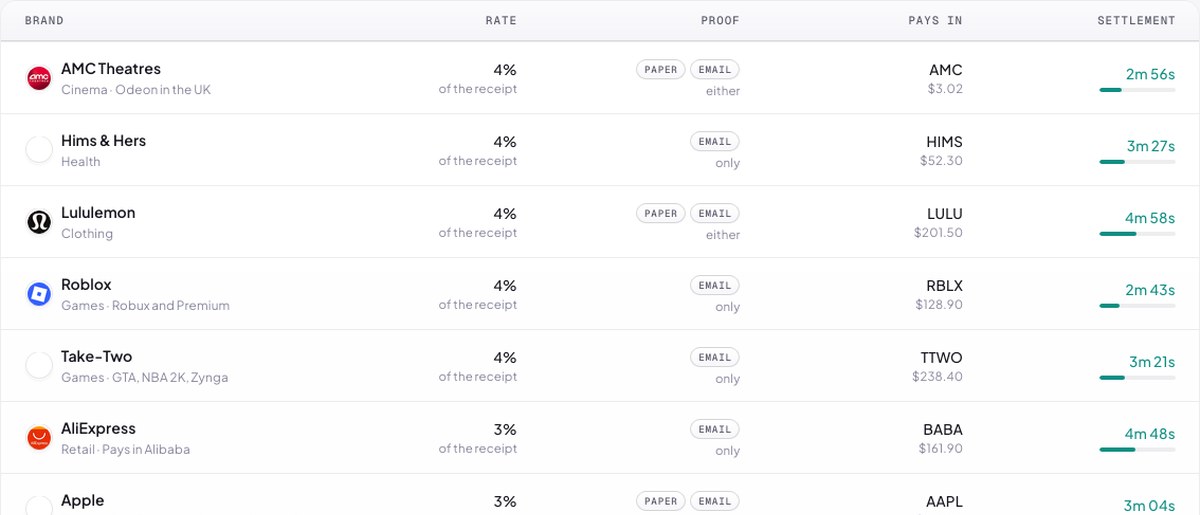
Every brand, with its settlement time
All thirty-eight brands that pay in their own stock, each carrying the rate the brand pays and how long the last hundred rewards took to land. In minutes, not "usually a few days". Sorted by what pays most, what settles fastest, or what you happen to be standing in.
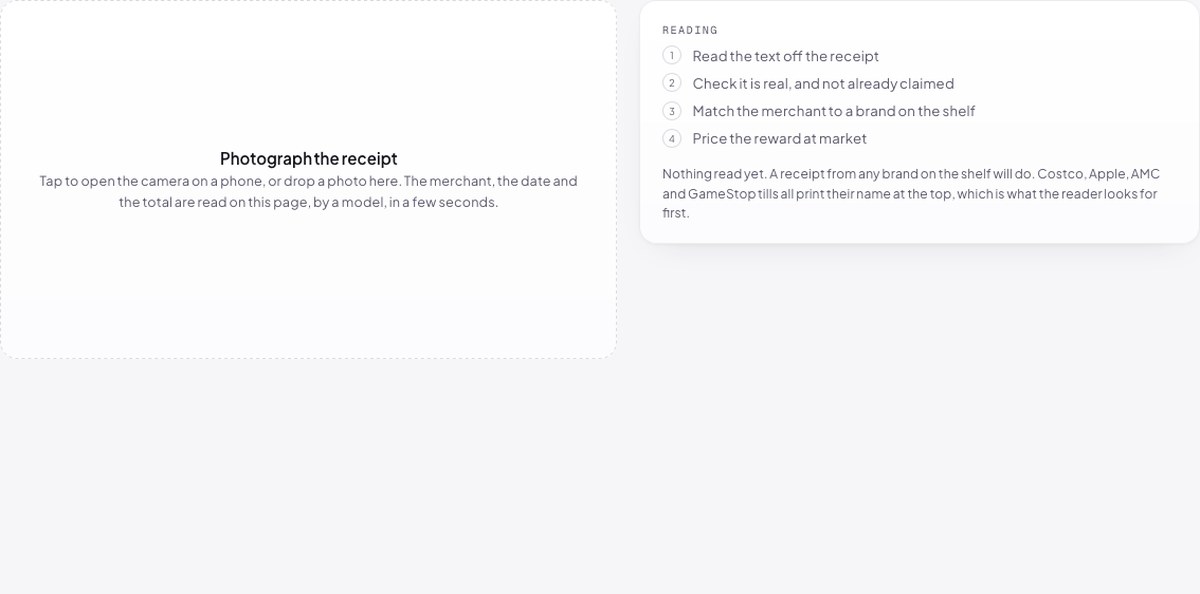
Receipts and emails, side by side
Paper from the till and confirmations from your inbox are two routes to the same claim. Both are marked on the shelf, so you know before you buy which one a brand accepts, and a subscription you already pay for becomes a monthly reward you never have to photograph.

Told plainly when a claim is turned away
A rejected receipt is explained, never silently dropped. Reprinted, already claimed, not from a brand on the shelf, older than thirty days: you see the reason on the claim itself, and the next one gets through. Rewards are stock, so a fake receipt is theft. The reading is built so the easy fakes cannot be sent at all.
Hold it, and the cap on every receipt moves from $20 to $100.
One token, two jobs. It raises the ceiling on what a single receipt can pay, and three quarters of what the protocol earns buys it back and burns it, every week, on chain. Nothing else is gated behind it.
About the token →
The receipt you were about to throw away
is a share of the company.
Photograph the next one. It is read in seconds, priced at market and settled in minutes, and the shelf tells you all three numbers before you start.